Showing posts with label biology. Show all posts

Friday, 14 May 2021

Why How and Which Animals Can Change Colors -10 Amazing Animals That Change Their Colors Other Than Chameleons and Humans


“Mother Nature is the greatest artist” -  Rico Besserdich


What comes to your mind first when you read or hear ‘color changing’ animals? Maybe a chameleon or people who constantly change their colors through their behavior. Therefore, I have not included Chameleon and humans in the following list as both of them are very popular in terms of color change and everyone is well aware of them. A wide variety of species of arthropods, cephalopods (squid, cuttlefish, octopuses, and their relatives), amphibians, reptiles, and fish can change color.


You can watch YouTube video on this topic which includes amazing short videos of these animals:  https://youtu.be/7pZO4pj7C0s 


First of all, let’s understand why the organism has to change its color. There are three main reasons to change color:

a)              to avoid predators (camouflage)

b)             to hunt

c)              to communicate (for mating, warning, etc)


How do organisms change their colors?

This depends on what species we are considering. The majority of species perform Metachrosis. Metachrosis is a mechanism by which rapid color change is done through the translocation of pigments and reorientation of reflective plates within small, sack-like organs known as chromatophores. Certain species of insects perform regulation of fluids within the exoskeleton which results in color change. Whereas, certain organisms do not have any control over color change, for this they depend on environmental conditions.


Here is the list of 10 organisms that can change their color:


Big Blue Octopus (Octopus cyanae)

1.     Big Blue Octopus (Octopus cyanae): It is found in the Indian and Pacific Oceans. This diurnal octopus has special cells called chromatophores. Whenever an octopus sees a prey or predator, then the brain of the octopus sends a signal to these chromatophores and changes the color. There are some muscles under the skin of the octopus that give a smooth or bumpy appearance to the octopus according to the environment.


White banded Crab Spider (Misuminoides formosipus)

2.    White  banded Crab Spider (Misuminoides formosipus): They are native to parts of the United States as well as Canada. The line or ridge-like appearance in the area near its face, below the eyes, earns the species its name. These spiders can change the colors between yellow and and it can take up to three days to change the colors. color is obtained due to present guanine and uric acid in their epidermis and yellow color is obtained due to ommochrome pigments. These spiders hide by changing the color between the flowers which is called camouflage and prey on the other insects/pollinators.


Common Cuttlefish

3.     Cuttlefish: Commonly known as cuttles, they are cephalopods of Order Sepiida. They are distributed around the world, and over 120 unique cuttlefish species have been discovered. Many species of cuttlefish can change color. Cuttlefish is also called the ‘Chameleon of The Sea’ because it can change the color of its skin within a second. Cuttlefishes use their skin color to avoid predators and for camouflage. They also change the color, pattern, and shape of their skin to communicate with other cuttlefish and to capture their prey. This is done by using chromatophores, iridophores, and leucophores under their skin.


Golden Tortoise Beetle (Charidotella sexpunctata)

4.     Golden Tortoise Beetle (Charidotella sexpunctata): The golden tortoise beetle is distributed widely in eastern North America, west to about Iowa and Texas.  Its color appears golden because it reflects light rays with fluids present in its exoskeleton. But when external conditions change the beetle has a rare ability to dry the fluids which changes its color to dark red. Its exoskeletons have numerous layers. It adjusts the fluid in it to reflect different wavelengths of light and displays a variety of color shades. Scientists have not found out why the beetles change color, but they think that this helps in avoiding predators by showing the beetle as a poisonous insect.


Pacific Tree Frog (Pseudacris regilla)

5.     Pacific Tree Frog (Pseudacris regilla): This amphibian is also known as the Pacific chorus frog. The Pacific Tree Frog ranges from British Columbia, Canada to the tip of Baja California, México, and eastward to Montana and Nevada. It can change its color from brown to green. But neither does it change the color to match its surroundings nor it controls this color change. Chromatophores under their skin change color according to air temperature and humidity, which means that color change depends on the environment, not on the frog.

Flounder (Flatfish)

6.     Flounders: They are a group of flatfish species. It changes color to match its surrounding. The process of changing colors and textures is very complex and its mechanism is not completely understood yet. It changes color in just 8 seconds and its eyes and hormones are involved in this process. By experiments, it is known that they can change colors like the Checkerboard of Chess.


Seahorses (Hippocampus sp.)

7.     Seahorses (Hippocampus sp.): Seahorses also change color chromatophores, which are embedded in their skin. Each chromatophore contains one of three or four pigments. Enlargement or retrenchment of the chromatophores via tiny muscles results in different colors being exhibited with varying intensity. The color change is used to avoid predators and to communicate with other Seahorses.

Mimic Octopus [left] mimicking the sea creatures (Flatfish, Lionfish, Seasnake)[right]

8.     Mimic Octopus (Thaumoctopus mimicus): It inhibits the Indo-Pacific oceans. This octopus changes color and mimics other animals such as sea snake, jellyfish, lionfish, sea anemone, mantis shrimp, crabs, and flatfish. It changes the color to frighten the predators, as camouflage, and to attract the prey. It is seen that mimic octopus can mimic the predator’s predator. It is intelligent enough to decide which mimicry behavior would be most suitable at moment and acts upon it. This octopus also has chromatophores under its skin.

Squid

9.     Squids: Squids are cephalopods of Superorder Decapodiformes whose skin is covered in controllable chromatophores of different colors, enabling the squid to match its coloration to its surroundings. They can also change colors like cuttlefish, octopus, and other cephalopods for camouflage, communication, protection, and hunting. Squid make use of diverse kinds of camouflage, namely dynamic camouflage for background corresponding (in shallow water) and counter-illumination (Bioluminescence). This helps to protect them from their predators and allows them to approach their prey.

 Betta Fish (Betta splendens)


10.  Betta Fishes (Betta splendens): It is endemic to the freshwaters of southeast Asia and is also known as Siamese Fighting Fish. It is an aquarium pet fish that changes color over time in response to the diet, age, aquarium conditions (temperature, pH, salinity, etc.) stress, or disease. Similar to the Pacific Tree Frog, it changes colors with respect to environmental changes. If you have this fish in your aquarium, you must have seen it changing colors.

Here ends the list of organisms that changes color. As I said in the beginning, there are many more such organisms in wild that change their color. Comment those which I have not enlisted in this list.

Here’s how you can support ZoologicalWisdom:

1)    Subscribe to the YouTube channel of ZoologicalWisdom.

2)    Follow us on Instagram/ Facebook.

3)    Share the videos/posts.

4)    Follow the ZoologicalWisdom’s Blog. (On Blogger or Medium or BuyMeACoffee)

5)    Give your feedback/suggestions in the comment sections.

Sunday, 2 May 2021

6 Mnemonic devices To Remember Taxonomic Hierarchy | Taxonomy Mnemonics | Biology Mnemonic In Hindi | Biology Short Tricks


mnemonic is a device or series of words that helps us remember certain facts or large amounts of information. They can come in the form of a song, rhyme, acronym, image, phrase, or sentence. Mnemonics help us remember facts and are particularly useful when the order of things is important. Taxonomy is a very important and vast topic. It is studied in biology lower classes at a basic level as well as in Zoology/Botany at a higher level. To remember the sequence of taxa in the Taxonomic hierarchy, mnemonics are given below. I hope this will be helpful.

The taxonomic Hierarchy in Kingdom Animalia consists of 8 major taxa. They are:

1.   Domain

2.  Kingdom

3.   Phylum

4.   Class

5.    Order

6.    Family

7.    Genus

8.    Species


x

    So, D-K-P-C-O-F-G-S are the initials of each taxon from which a mnemonical sentence can be formed. Here are 6 mnemonic devices to memorize the taxonomic classification system in the above-mentioned sequence.

1. Dear King Plays Chess On Fine Green Slate/Sand.

2. Dangerous Kangaroo Punches Charles On Five Gum Sores.

3. Did King Phillip Came Over For Great Spaghetti/Soup?

4. David Kelly Please Catch Only Four Green Snakes.

5. Do Kindly Place Candy Out For Good Students.

6. Deer Killed Painfully Cries On Five Gun Shots.

To learn more about taxonomy and biological classification watch:

All About Taxonomy | TAXONOMIC HIERARCHY | TAXONOMY EXPLAINED: https://youtu.be/ACMy4t0HM-Q

History of Biological Classification | All About Biological Nomenclature | Rules Advantages & Codes: https://youtu.be/nwllwWVE-5M

Zoological Wisdom Links:-

Instagram Page: https://www.instagram.com/zoologicalwisdom/

Facebook Page: https://www.facebook.com/ZoologicalWisdom/

Buy me a coffee Page: https://www.buymeacoffee.com/Zoologicalwisdo

Blogger: https://zoologicalwisdom.blogspot.com

Medium: http://zoologicalwisdom.medium.com

Thursday, 1 April 2021

ARE YOU CHOOSING YOUR CAREER OR SOMEONE ELSE IS DOING IT FOR YOU ?

          This article is exclusively for those students and their parents who are busy deciding their career path. In today's competitive world, participation in the rat race is preferred over the interests of a person. In this world, happiness is achieved through the satisfaction that one is better than the other and not by doing what we like. The rat race begins in one's life when that person is forced, obligated or convinced to choose a certain career. At this very point in life, a person kills his/her interests when he/she tends to do what someone else is telling him/her to do. This is the reason behind why we often hear people saying that "I am bored of this job or profession". If a person does what he/she likes the most, there is no chance of getting bored in future this is what I think. In between all of this, the importance of some courses is degraded to glorify certain courses which are disliked by the student. This has resulted in the selection of a handful of courses that are glorified and are considered prestigious by people over generations.


93% Indian students aware of just seven career options as per reported by India today’s survey which got responses from 10,000 students of age group 14 to 21 years. According to researchers, India has a variety of 250 career options offered across 40 fields covering 5,000 job types.


Zoology is one of such subjects which people think is of no use. Zoology is a branch of biology that studies overall aspects of the animal kingdom, which is an important part of Earth and Nature. In my case, when I tell the people that I am pursuing a degree of science in Zoology, a kind of question mark appears on their faces. They have no idea about it. Some of them even try to convince me to change the course and study something else. “What will you do afterwards, there is no scope in it, the pay scale is too low, etc.?” I hear many such things from almost every person I meet who doesn't have any idea about the complexity, vastness and future of this course. Animals, environment, forests, sustainable development, wildlife, etc. "Who cares about them?" is a common misconception in minds of such people. But my parents supported my decision of choosing zoology as major subject for my bachelor’s degree, because I was able to convince them and explained them the scope of this field. That is what matters to me and I think no one else has any right to comment about someone’s career choice.

There are many instances where parents are seen to suggest, explain, convince even force the child to opt specific courses. There is nothing wrong with that because the parents feel that their child must have a good life or even better life than theirs. Now, here it is the responsibility of the child to convince the parents most ethically and scientifically. The child should express his/her interest, why he/she is willing to do that course, what is the scope, what are the pros and cons, what are the job profiles, what are your goals, make them read this article, etc. There must be a positive level of transparency between you and your parents so that they can believe in you. The important factor which can influence your parents is the scope of this course and job profile. Dear parents, neither science is greater to commerce nor medical/engineering is greater than bachelor’s degree. Every course exists and is offered because it has distinct level of importance in separate dimensions of life. I hope this article was successful in its motive. At the end of the day its your life and what I think is your life is your making.

-Meehir Pawar

Instagram, YouTube, Buy me a coffee Page


Thursday, 4 March 2021

INVERTEBRATES: INTRODUCTION

What are invertebrates?

The animals which lack the backbone or the vertebral column are referred to as Invertebrates. All such animals are included in a group called Invertebrata.


Also, animals are often categorized into two major groups : the chordates and the non-chordates. This categorisation or division is based on the presence or absence of the singular character the notochord. It is a stiff rod-like structure which serves as an internal skeleton.

Animals without notochord are called non-chordates and those with vertebral column are called chordates. Non-chordate and invertebrate are the terms often used for each other as synonyms but their meanings differ. For an instance, protochordates are all invertebrates because of the absence of vertebral column but they still are chordates due to presence of notochord. Thus, all the non-chordates are invertebrates whereas all invertebrates are not non-chordate.


Presently, there are about 30 invertebrate phyla which are characterized by the unity of basic structural pattern in each of them. For example, Phylum Arthropoda which includes insects, arachnids, crustaceans, etc. has an estimated 9,99,059 identified species or 85% of total identified animal species. Apart from arthropods, the invertebrates number reaches 12,38,000 or 94% excluding viruses and bacteria.

Significance of invertebrates:
Well-known biologist E. O. Wilson has described the invertebrates as, "little things which run the world". Invertebrates are a portion of nearly every food chain directly as food for fishes, amphibians, reptiles, birds, mammals or indirectly as agents in the continual recycling of nutrients in the soil. Food webs depend on these creatures executing essential procedures such as pollination or seed dispersal. We can't think of living on the earth without the existence of invertebrates.

Importance of study of invertebrates:
The study of invertebrates has acquainted us with their involvement in the significant effects on the sustainability of numerous agrarian products. Invertebrates and microorganisms play an important role in detoxifying pesticides, nurturing and enhancing the fertility, reducing the effects of pollutants and also in biological control of agricultural pests. Many invertebrates are deadly to humans as parasites (nematodes) or as vectors for serious human diseases (mites, mosquitoes).


To watch a video regarding this topic. Please visit Youtube channel of ZoologicalWisdom

https://youtu.be/pWgK01HsAkc

Wednesday, 3 March 2021

DETAIL ABOUT BSc. BIOTECHNOLOGY

Choosing a career after 12th is a huge challenge. Here's the detail about a course one should opt after 12th exams.

What is BSc biotechnology

B.Sc. Biotechnology or Bachelor of Science in biotechnology is a 3 years undergraduate biotechnology course. Biotechnology is a branch of science that use biology to solve problems and make useful products. The syllabus is divided into six semesters. Here, students have to study basics topics like microbiology, Biomathematics, biochemistry, genetics, cytology, Chemistry, biostatistics, enzymes, Intellectual Property Rights, etc.

Eligibility Criteria:

The minimum eligibility for admission in BSc in Biotechnology is a Class 12th pass in Science Stream with at least 50% aggregate marks. Candidates must have studied Physics, Chemistry, and Biology in Class 12. Some Institutes or Universities may conduct entrance exams for the same.

Who should opt?
Those who are interested and are curious about biological sciences on molecular & genetic level and wants to explore more in this field.
Those who have good problem-solving skills and are proficient with computer and also have the ability to work both independently and as part of a team.
Those who have good analytical data handling and written communication skills and can conduct detailed work precisely with an the ability to plan research, analyze and interpret data, report writing and practical skills.
Those who want to go for further studies or research.
Those who are interested in laboratory research.

What after BSc Biotechnology?
One can pursue post-graduation (M.Sc.) in Biotechnology after doing undergraduation.
Biotechnology has wide range of courses thus giving opportunities to specialize/research into many of them like food technology, biomedical and industrial,  biotechnology, epidemiology, marine biology, forensic science, bioinformatics, enzymology, etc.
The most prominent area of biotechnology is the production of therapeutic proteins and other drugs through genetic engineering.
One can also appear for UPSC or state-level public commission exam or civil service examination.
One can also pursue MBA in biotechnology management and MBA in Pharmaceuticals

Job opportunities after BSc Zoology
One can apply for Biotechnology engineer, Biotech analysts, Lab technician, Project manager, research assistant, Teacher, Microbiologists, Epidemiologists, biostatistician, bioproduction, Operators, biomanufacturing specialists, etc. in Research firms, Hospitals, Waste management sectors, Pharmaceuticals, Food production firms, Clinical research firms, Laboratories, etc

People sometimes misinterpret bsc biotechnology as BTech biotechnology. One must understand that they are not comparable. BSc in Biotechnology deals with basic and applied aspects of all fields of biotechnology, especially human health. It is a baseline for MSc that may culminate in a PhD. Whereas, BTech course deals mostly with the engineering and applied aspects of the field.

POPULATION GENETICS: INTRODUCTION

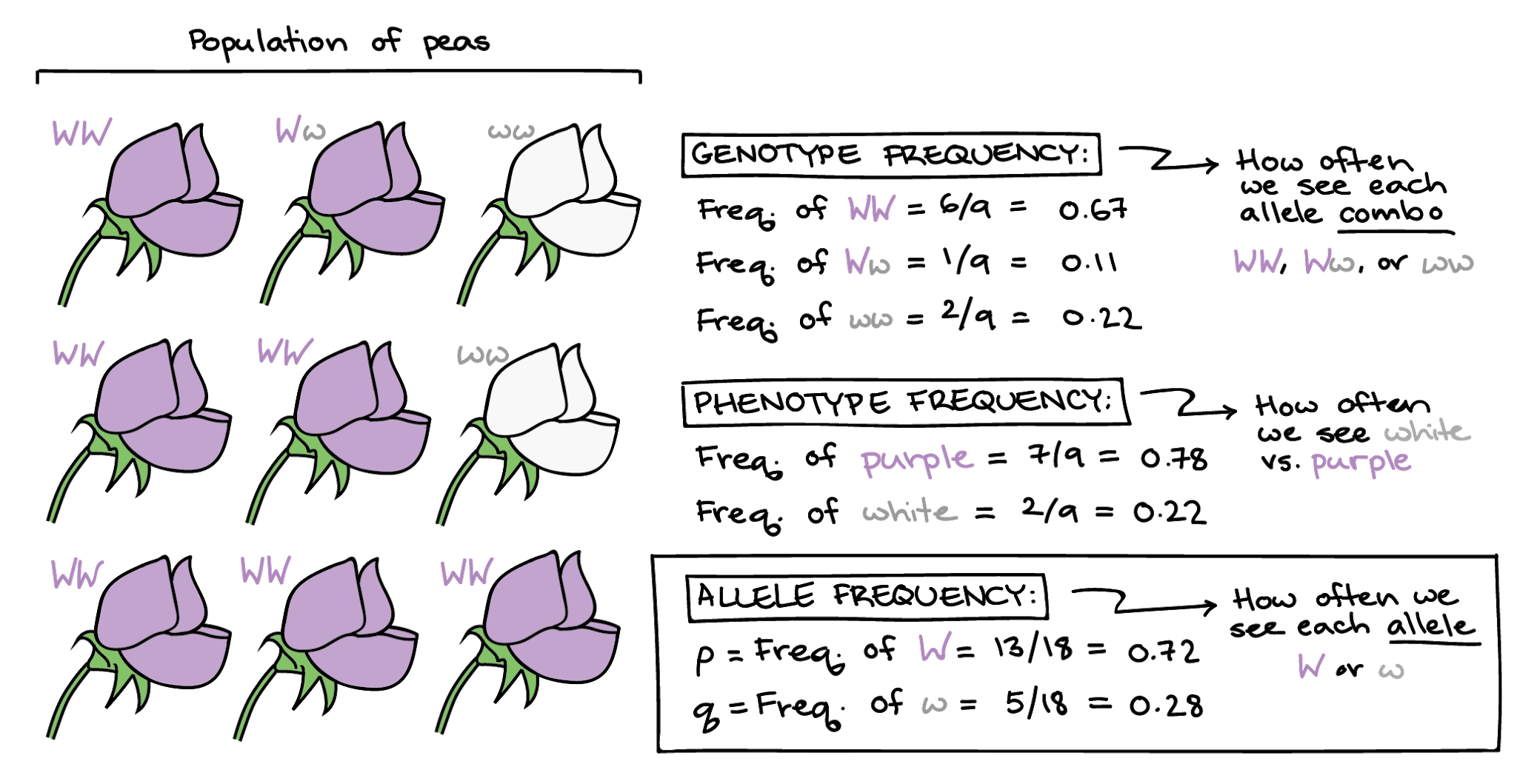
Population genetics: It is a branch of genetics that studies the distribution or changes in the frequency of allele and genetic variation in or between populations leading to Evolution.

Population: Generally, the population is defined as a group of organisms of the same species inhabiting a specific area at a given time.
The new definition of the population is, "the population is an ultimate self-reproducing grouping of specific individuals which occupies a definite area over an evolutionary long period to form an independent genetic system and an ecological niche of its own".

Gene pool: It is the sum of the genetic material of a population at a given time. This term is typically used in relation to a population made up of individuals of the same species and includes all genes and combinations of genes (sum of the alleles) in the population.

Allele frequency: It is the measure of how much an allele is frequent in a population.
It is calculated by the number of particular alleles divided by the total number of alleles present in the given population

Phenotype frequency: A ratio stating the number of times a specific phenotype occurs in a population in a single generation. It is calculated by the number of a particular phenotype divided by the total number of individuals in that population.

Genotypes frequency: Genotype frequency in a population is the number of individuals with a given genotype divided by the total number of individuals in the population. It is calculated by the number of a particular genotype divided by the total number of individuals in that population.


Microevolution: "The change in allele frequency over a period of time in a particular population is defined as Microevolution". This change is due to four different processes: mutation, selection (natural and artificial), gene flow and genetic drift. This change happens over a relatively short (in evolutionary terms) amount of time compared to the changes termed macroevolution. The mathematical structure for the study of the process of microevolution is studied through population genetics. Pesticide resistance, herbicide resistance, and antibiotic resistance are all examples of microevolution by natural selection. 

HARDY-WEINBERG LAW

Hardy-Weinberg law was discovered independently in 1908 by Wilhelm Weinberg, a German physician, and Godfrey Harold Hardy, a British mathematician.


The Hardy-Weinberg law states that,

"In a large, random-mating population, the genotype and allele frequencies remain constant in the absence of any evolutionary influences from one to another generation."


The conditions to maintain the Hardy-Weinberg equilibrium are: no mutation, no gene flow, large population size, random mating, and no natural selection. Because all of these disruptive forces commonly occur in nature, the Hardy-Weinberg equilibrium rarely applies in reality.


The Hardy-Weinberg formulas allow scientists to determine genetic equilibrium or whether evolution has occurred in a population. 

Two formulas must be memorized:

p2 + 2pq + q2 = 1 and p + q = 1

p = frequency of the dominant allele in the population

q = frequency of the recessive allele in the population

p2 = percentage of homozygous dominant individuals

q2 = percentage of homozygous recessive individuals

2pq = percentage of heterozygous individuals


Some of the major factors which affect the genetic equilibrium and induce the variability in a population are as follows: (A) Mutations (B) Recombinations during Sexual Reproduction (C) Genetic Drift (D) Gene Migration (Gene Flow) (E) Natural Selection.

This Will be explained in detail in upcoming posts


Applications:

Medical geneticists can use the Hardy-Weinberg law to calculate the probability of human matings that may result in defective offspring. The law is also useful in determining whether the number of harmful mutations in a population is increasing as a result of radiation from industrial processes, medical techniques, and fallout.