Population genetics: It is a branch of genetics that studies the distribution or changes in the frequency of allele and genetic variation in or between populations leading to Evolution.
Population: Generally, the population is defined as a group of organisms of the same species inhabiting a specific area at a given time.
The new definition of the population is, "the population is an ultimate self-reproducing grouping of specific individuals which occupies a definite area over an evolutionary long period to form an independent genetic system and an ecological niche of its own".
Gene pool: It is the sum of the genetic material of a population at a given time. This term is typically used in relation to a population made up of individuals of the same species and includes all genes and combinations of genes (sum of the alleles) in the population.
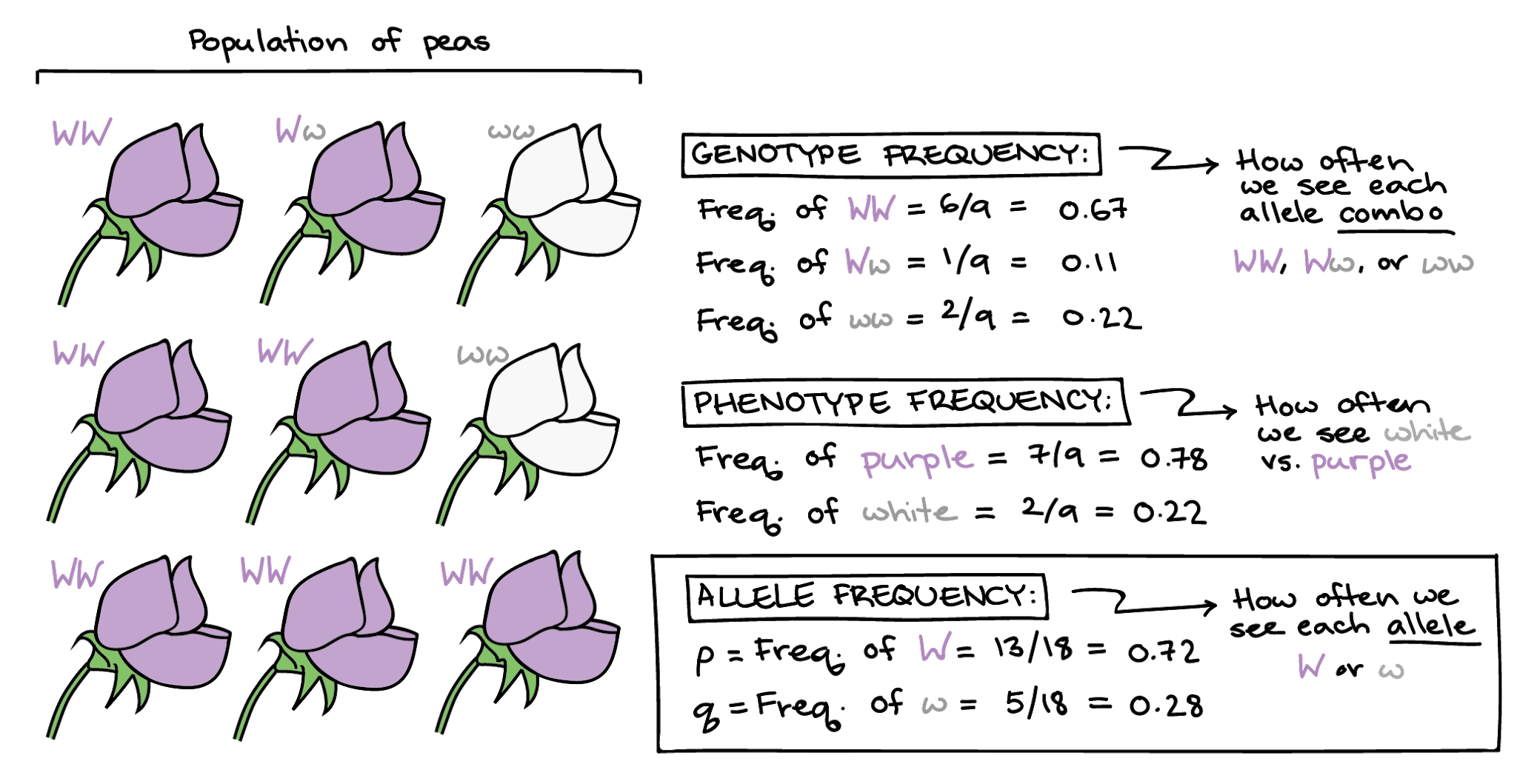
Allele frequency: It is the measure of how much an allele is frequent in a population.
It is calculated by the number of particular alleles divided by the total number of alleles present in the given population
Phenotype frequency: A ratio stating the number of times a specific phenotype occurs in a population in a single generation. It is calculated by the number of a particular phenotype divided by the total number of individuals in that population.
Genotypes frequency: Genotype frequency in a population is the number of individuals with a given genotype divided by the total number of individuals in the population. It is calculated by the number of a particular genotype divided by the total number of individuals in that population.
Microevolution: "The change in allele frequency over a period of time in a particular population is defined as Microevolution". This change is due to four different processes: mutation, selection (natural and artificial), gene flow and genetic drift. This change happens over a relatively short (in evolutionary terms) amount of time compared to the changes termed macroevolution. The mathematical structure for the study of the process of microevolution is studied through population genetics. Pesticide resistance, herbicide resistance, and antibiotic resistance are all examples of microevolution by natural selection.
