Showing posts with label BSC. Show all posts

Wednesday, 3 March 2021

DETAIL ABOUT BSc. BIOTECHNOLOGY

Choosing a career after 12th is a huge challenge. Here's the detail about a course one should opt after 12th exams.

What is BSc biotechnology

B.Sc. Biotechnology or Bachelor of Science in biotechnology is a 3 years undergraduate biotechnology course. Biotechnology is a branch of science that use biology to solve problems and make useful products. The syllabus is divided into six semesters. Here, students have to study basics topics like microbiology, Biomathematics, biochemistry, genetics, cytology, Chemistry, biostatistics, enzymes, Intellectual Property Rights, etc.

Eligibility Criteria:

The minimum eligibility for admission in BSc in Biotechnology is a Class 12th pass in Science Stream with at least 50% aggregate marks. Candidates must have studied Physics, Chemistry, and Biology in Class 12. Some Institutes or Universities may conduct entrance exams for the same.

Who should opt?
Those who are interested and are curious about biological sciences on molecular & genetic level and wants to explore more in this field.
Those who have good problem-solving skills and are proficient with computer and also have the ability to work both independently and as part of a team.
Those who have good analytical data handling and written communication skills and can conduct detailed work precisely with an the ability to plan research, analyze and interpret data, report writing and practical skills.
Those who want to go for further studies or research.
Those who are interested in laboratory research.

What after BSc Biotechnology?
One can pursue post-graduation (M.Sc.) in Biotechnology after doing undergraduation.
Biotechnology has wide range of courses thus giving opportunities to specialize/research into many of them like food technology, biomedical and industrial,  biotechnology, epidemiology, marine biology, forensic science, bioinformatics, enzymology, etc.
The most prominent area of biotechnology is the production of therapeutic proteins and other drugs through genetic engineering.
One can also appear for UPSC or state-level public commission exam or civil service examination.
One can also pursue MBA in biotechnology management and MBA in Pharmaceuticals

Job opportunities after BSc Zoology
One can apply for Biotechnology engineer, Biotech analysts, Lab technician, Project manager, research assistant, Teacher, Microbiologists, Epidemiologists, biostatistician, bioproduction, Operators, biomanufacturing specialists, etc. in Research firms, Hospitals, Waste management sectors, Pharmaceuticals, Food production firms, Clinical research firms, Laboratories, etc

People sometimes misinterpret bsc biotechnology as BTech biotechnology. One must understand that they are not comparable. BSc in Biotechnology deals with basic and applied aspects of all fields of biotechnology, especially human health. It is a baseline for MSc that may culminate in a PhD. Whereas, BTech course deals mostly with the engineering and applied aspects of the field.

POPULATION GENETICS: INTRODUCTION

Population genetics: It is a branch of genetics that studies the distribution or changes in the frequency of allele and genetic variation in or between populations leading to Evolution.

Population: Generally, the population is defined as a group of organisms of the same species inhabiting a specific area at a given time.
The new definition of the population is, "the population is an ultimate self-reproducing grouping of specific individuals which occupies a definite area over an evolutionary long period to form an independent genetic system and an ecological niche of its own".

Gene pool: It is the sum of the genetic material of a population at a given time. This term is typically used in relation to a population made up of individuals of the same species and includes all genes and combinations of genes (sum of the alleles) in the population.

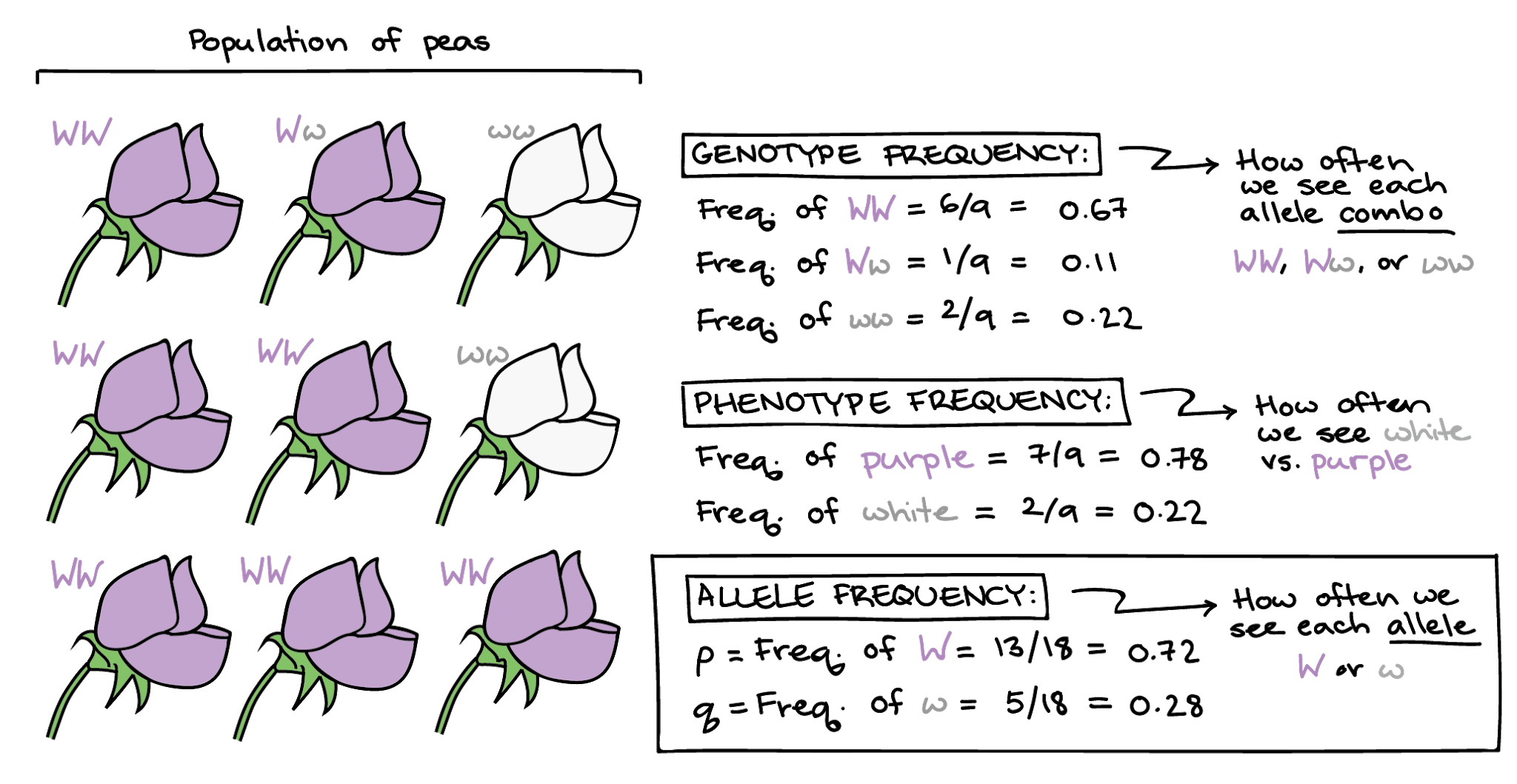
Allele frequency: It is the measure of how much an allele is frequent in a population.
It is calculated by the number of particular alleles divided by the total number of alleles present in the given population

Phenotype frequency: A ratio stating the number of times a specific phenotype occurs in a population in a single generation. It is calculated by the number of a particular phenotype divided by the total number of individuals in that population.

Genotypes frequency: Genotype frequency in a population is the number of individuals with a given genotype divided by the total number of individuals in the population. It is calculated by the number of a particular genotype divided by the total number of individuals in that population.


Microevolution: "The change in allele frequency over a period of time in a particular population is defined as Microevolution". This change is due to four different processes: mutation, selection (natural and artificial), gene flow and genetic drift. This change happens over a relatively short (in evolutionary terms) amount of time compared to the changes termed macroevolution. The mathematical structure for the study of the process of microevolution is studied through population genetics. Pesticide resistance, herbicide resistance, and antibiotic resistance are all examples of microevolution by natural selection. 

HARDY-WEINBERG LAW

Hardy-Weinberg law was discovered independently in 1908 by Wilhelm Weinberg, a German physician, and Godfrey Harold Hardy, a British mathematician.


The Hardy-Weinberg law states that,

"In a large, random-mating population, the genotype and allele frequencies remain constant in the absence of any evolutionary influences from one to another generation."


The conditions to maintain the Hardy-Weinberg equilibrium are: no mutation, no gene flow, large population size, random mating, and no natural selection. Because all of these disruptive forces commonly occur in nature, the Hardy-Weinberg equilibrium rarely applies in reality.


The Hardy-Weinberg formulas allow scientists to determine genetic equilibrium or whether evolution has occurred in a population. 

Two formulas must be memorized:

p2 + 2pq + q2 = 1 and p + q = 1

p = frequency of the dominant allele in the population

q = frequency of the recessive allele in the population

p2 = percentage of homozygous dominant individuals

q2 = percentage of homozygous recessive individuals

2pq = percentage of heterozygous individuals


Some of the major factors which affect the genetic equilibrium and induce the variability in a population are as follows: (A) Mutations (B) Recombinations during Sexual Reproduction (C) Genetic Drift (D) Gene Migration (Gene Flow) (E) Natural Selection.

This Will be explained in detail in upcoming posts


Applications:

Medical geneticists can use the Hardy-Weinberg law to calculate the probability of human matings that may result in defective offspring. The law is also useful in determining whether the number of harmful mutations in a population is increasing as a result of radiation from industrial processes, medical techniques, and fallout.